• Hey Guest,

    We wanted to share a quick update with the community.

    Our public expense ledger is now live, allowing anyone to see how donations are used to support the ongoing operation of the site.

    👉 View the ledger here

    Over the past year, increased regulatory pressure in multiple regions like UK OFCOM and Australia's eSafety has led to higher operational costs, including infrastructure, security, and the need to work with more specialized service providers to keep the site online and stable.

    If you value the community and would like to help support its continued operation, donations are greatly appreciated. If you wish to donate via Bank Transfer or other options, please open a ticket.

    Donate via cryptocurrency:

    Bitcoin (BTC):
    Ethereum (ETH):
    Monero (XMR):
Sphinxi

Sphinxi

Student
Jan 4, 2026
102
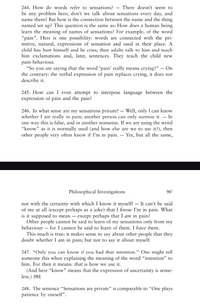
I'm rereading Wittgenstein currently, specifically the latter half of the investigations, and I came across this passage:

Do you think that he is correct here, that we can never really communicate our feelings of pain to another person? That all we can do is gesture at the cluster of concepts we understand as pain, and hope that another person understands what this means? It seems to be correct. We can never properly communicate the feeling of pain itself, nor a feeling of pleasure, or of nostalgia.

What are your thoughts on this? Does this seeming impossibility bother you?
 

Attachments

  • Screenshot_20260110-180930.png
    Screenshot_20260110-180930.png
    463.4 KB · Views: 0
  • Like
  • Informative
Reactions: Forever Sleep, avalon_, Dejected 55 and 1 other person
U. A.

U. A.

"Ultra Based Gigachad"
Aug 8, 2022
2,415
Hidden content
You need -1 more posts to view this content
 
  • Love
Reactions: gunmetalblue
Dejected 55

Dejected 55

Visionary
May 7, 2025
2,345
The problem with some things is, when they are subjective rather than objective, it is all but impossible to know that you are communicating exactly what you mean to be communicating.

When you see what you call the color RED, how do you know that I see RED the same way as you? Even if we both can point at RED things and agree that we both consider them RED... how do you know that you and I see the exact same thing? There are some studies that indicate people do not necessarily all see colors the same way even when we agree that we are looking at the "same" color.

How does pain feel for you? If you stub your toe does it feel the same to you as it does when I stub my toe? Even if we both agree that the action hurts, do we really know that we feel the same kind/level of pain?

Some people like the way pains of certain kinds feel... most of us don't. My mother really liked the smell of gasoline. Not to get high, she just liked the smell of it. Most people do not. We do not all agree on how foods taste, some of us like things that others don't. Some of us like pizza but not as much as others who like pizza. Even if we both think we really really like pizza, how do we know it means the same to us?

I think it is partly a limitation of language... but it's also going to always be a limitation of being unable to 100% know what it is like to be someone else and feel as they feel.
 
X

X-sanguinate86

Experienced
Sep 26, 2025
225
I'm pretty sure we'll be getting a taste of some limitations in this thread. How do I know all caps or italic is the same all caps or italic to you? How do I know what's cringe to you is cringe to me...
 
H

Hvergelmir

Warlock
May 5, 2024
708
What are your thoughts on this?
With no doubt, there are limitations not just to language, but communication.
Does this seeming impossibility bother you?
Not at all. The opposite would be scary, implying very advanced mind reading capabilities.
To fully and thoroughly understand my feeling you'd have to fully and thoroughly understand me. That would give you a lot of power.
 
F

Forever Sleep

Earned it we have...
May 4, 2022
14,372
It isn't just language though- when it comes to assessing pain. Some people are so empathetic that- if they see another person crying- they will cry too. They may cry even more if they find out and relate to what that other person is upset about of course. But, some of it must be to do with our sensitivity/ empathy rather than language.

We can find different things upsetting too. Music is probably more likely to make me cry than reading or hearing something sad in written/ spoken language.

But sure- language isn't really an accurate description of pain. Because we aren't always honest- for one. Plus, we only have so many things to compare it to. I did really badly out of the whole: 'How bad is your pain on a scale of 1-10'. I had gallstone trouble (unknown) at the time. It was absolutely the worst pain I'd ever experienced but then it's like- what do you want me to compare it to? I've never broken a bone. I've never pulled a tendon. I've never given birth. I can imagine those things to be very painful. As such though, I probably downgraded it and they let things slide. I should have just said 9 or 10.

But, we can do both. Exagerate or not even have the words for how painful something is. It would be better really if we could somehow accurately measure it.
 
PureEndless

PureEndless

Member
Jul 11, 2025
36
I have a brain disease that medicine is debating whether it exists. It's a horrible pain you wouldn't wish on your worst enemy.

I have used every word in the dictionary, every study, every paperwork, I've had family come in and advocate for me.

Some doctors believe it. I've started treatment eventually. But many of them, for years, did not. Many acted annoyed or as if I was lying or wasting their time.

In speaking with many people over the years, this is very, very common in neurology. It's not a very good medical practice. It has a lot of work yet to discover. The tests aren't very good. But the doctors never want to admit this. I've met so many people in the same situation: in horrible pain that's led to losing a job or their entire life. And they are just met with a stare by the doctor.

The words aren't enough. You cannot change the mind of dogma. When someone believes you are wrong, they believe you are wrong.

Science wasn't enough either. The moment we believe science is perfect, we fail. Because it's man-made. And humans are imperfect. So it has more to learn, always. But the moment it believes it is perfect, it cannot see the flaws within it.

The worst thing is when you speak of your pain, and the humans around you are convinced that it is not real, so the more you use words to speak of it, the more it just annoys them. And they create a new story. Perhaps you are mistaken, or faking, or are lying to gain attention....or something.

Language works if people believe you. If there's proof. But all we have is what we have. We have science and medicine to take tests, and seek proof. But if the tests come back "normal", then your language must be false then, if science is perfect.

You can speak and speak of your pain, but no one has to believe it.

Now if somehow they could feel the pain, we wouldn't need tests or language or anything.

That's the universal language.

They'd understand in seconds.

Is there an interface that would allow us to enter into someone else's body, so that we could feel what they feel, and see if they are lying, or exaggerating, and see what it is they are talking about?

Maybe they'll figure it out one day. I believe that would be the universal language.

 
  • Like
  • Love
Reactions: avalon_ and serenitydream
HawkTalon

HawkTalon

Member
Jan 15, 2026
12
Human language isn't much better than the barking of dogs when it comes to conveying our experiences of being, I agree. In fact, I'd say it's a far more difficult thing than conveying things such as philosophical or mathematical abstractions because each human being has their own uniquely perceived reality. I'm not suggesting that there is no one shared universal reality; that's a whole other topic entirely, but our experiences of that reality are each so different, and the words we gather to form the language used to describe our interactions with it often carry different barriers, nuances, feelings, etc., that are typically only sufficient at expressing generalities or approximations when it comes to such matters.

In regards to how I feel about it, I'm not sure. Due to a significant part of communication being non-verbal, I prefer to speak to people in the real world, as there's a greater chance that I can be understood than merely by words on a computer screen.
 
DarkRange55

DarkRange55

Let them eat cake! 🍰
Oct 15, 2023
2,263
For anyone who has time on the color question 🙋‍♀️

A lot languages were limited in their vocabulary of color until the industrial revolution.
Russians didn't have a word for blue until the 1950's, etc.


Highly recommend the last video


Similar threads