

C
c3po
Member
- May 5, 2026
- 12
Hello,
I was wondering why oxazepam is recommended as a benzodiazepine in the PPEH. There are so many different benzodiazepines. According to my research, they differ in terms of the time it takes for the effects to kick in, the rate at which they take effect (rapid or slow onset), and the duration of action. They also differ in how they are metabolized and their breakdown products, but at least for suicidal individuals who succeed in their attempt, that should be secondary.
First, some preliminary thoughts:
The different types of benzos thus differ in their subjective and objective effects; some tend to trigger anxiety, others numb, and still others induce euphoria. In reality, one must carefully select the appropriate benzos; it may not be sufficient to simply adjust the dosage using any "pill calculator" available online.
The authors of the PPEN are Australian. In Australia, as in some European countries, oxazepam is the most commonly prescribed benzodiazepine. It therefore stands to reason that it is the easiest benzodiazepine to obtain in these countries (provided one stays within the legal framework and does not procure benzodiazepines through illegal channels, which is of course an option for some).
Oxazepam has several advantages over other benzodiazepines, such as a lower risk of dependence, more favorable metabolism, and more favorable breakdown products; its effects set in slowly and steadily, rather than all at once like with Valium or similar drugs. In general, Oxa is a comparatively "mild" benzodiazepine. Well, for suicidal individuals, these are unimportant details. Or perhaps they are important after all: According to AI, the effects of Oxa tablets set in after 60 minutes and after 30 minutes for the powder. If the suicide proceeds as planned and the nitrite already leads to unconsciousness quickly, isn't that far too late? Is the effect of the benzos even needed after 30 minutes? Or is that only for cases where the person has vomited up part of the SN, so they suffer less and don't have to call an ambulance?
There is one thing that is very important for people attempting suicide:
*** Speed of onset. It must be neither too fast nor too slow.
The question is, what is the goal of using benzos in the first place:
1. A placebo effect intended to reduce anxiety and thus the likelihood of vomiting?
2. Unconsciousness, so that the transition to death is easier?
I suspect that Nitschke & Stewart (the authors of PPEH) didn't really think through which benzodiazepine is best in terms of its efficacy and side effect profile. I've often noticed that the PPEH sometimes seems imprecise or half-baked when you look at it.
One distinctive feature of Oxa is that its effects "kick in" more slowly than with other benzodiazepines. According to the literature, it takes 60 minutes for the pills to take effect, or 30 minutes if you crush them in a mortar, mix them with water, and drink the mixture. According to PPEH, however, unconsciousness sets in after about 12 minutes—apparently as a result of nitrite poisoning? Judging by the reports here in the forum, however, this does not always seem to be the case; some are still conscious hours later and able to call emergency services.
The question is, why do you even need the benzodiazepine then?
I have never taken benzodiazepines, so I'm asking those with benzodiazepine experience to share their insights: Does it really take an hour for Oxa pills to take effect?
Also, Oxa offers little potential for euphoric feelings, as SN users sometimes describe (there are better options for that).
In the US, Xanax is the most commonly prescribed benzodiazepine and is therefore likely the easiest to obtain legally there. With Xanax, the effects kick in much faster than with Oxa and are also much more sudden. This naturally raises the question: Isn't it contraindicated if you lose consciousness before you have a chance to drink a potentially necessary second glass of SN solution? Or is a second glass no longer necessary with Xanax because the loss of consciousness prevents vomiting, thereby making a second glass of SN solution unnecessary?
Shouldn't we do it this way instead:
Point A. A low-dose (1–2 pills), fast-acting benzodiazepine, such as alprazolam, which primarily relieves anxiety and might even make you feel a little euphoric. Take this perhaps 15 minutes before the SN. To make things generally easier and to prevent any psychologically induced nausea and other issues (nausea that originates in the mouth itself or in the stomach lining is not (!) suppressed by the usual anti-nausea medications, Meto and Ondo).
Point B. A slow-acting benzodiazepine that ensures a long period of deep sleep (e.g., Oxa, Valium, Tavor, or similar), in case the nitrite takes longer than 40 minutes to finish its effect.
Although the PPEH only makes a recommendation for Point B., Point A. seems more important to me?
If I haven't overlooked anything, there isn't yet a thread in the forum that addresses the complexity and variety of the different types of benzos. Or perhaps I've missed it; in that case, I'd appreciate it if you could post any relevant links or threads here.
Here's to a lively debate and interesting comments! :)
Best regards,
c3po
P.S.:
Here are a few additional notes that I didn't include elsewhere in the text:
I was wondering why oxazepam is recommended as a benzodiazepine in the PPEH. There are so many different benzodiazepines. According to my research, they differ in terms of the time it takes for the effects to kick in, the rate at which they take effect (rapid or slow onset), and the duration of action. They also differ in how they are metabolized and their breakdown products, but at least for suicidal individuals who succeed in their attempt, that should be secondary.
First, some preliminary thoughts:
The different types of benzos thus differ in their subjective and objective effects; some tend to trigger anxiety, others numb, and still others induce euphoria. In reality, one must carefully select the appropriate benzos; it may not be sufficient to simply adjust the dosage using any "pill calculator" available online.
The authors of the PPEN are Australian. In Australia, as in some European countries, oxazepam is the most commonly prescribed benzodiazepine. It therefore stands to reason that it is the easiest benzodiazepine to obtain in these countries (provided one stays within the legal framework and does not procure benzodiazepines through illegal channels, which is of course an option for some).
Oxazepam has several advantages over other benzodiazepines, such as a lower risk of dependence, more favorable metabolism, and more favorable breakdown products; its effects set in slowly and steadily, rather than all at once like with Valium or similar drugs. In general, Oxa is a comparatively "mild" benzodiazepine. Well, for suicidal individuals, these are unimportant details. Or perhaps they are important after all: According to AI, the effects of Oxa tablets set in after 60 minutes and after 30 minutes for the powder. If the suicide proceeds as planned and the nitrite already leads to unconsciousness quickly, isn't that far too late? Is the effect of the benzos even needed after 30 minutes? Or is that only for cases where the person has vomited up part of the SN, so they suffer less and don't have to call an ambulance?
There is one thing that is very important for people attempting suicide:
*** Speed of onset. It must be neither too fast nor too slow.
The question is, what is the goal of using benzos in the first place:
1. A placebo effect intended to reduce anxiety and thus the likelihood of vomiting?
2. Unconsciousness, so that the transition to death is easier?
One distinctive feature of Oxa is that its effects "kick in" more slowly than with other benzodiazepines. According to the literature, it takes 60 minutes for the pills to take effect, or 30 minutes if you crush them in a mortar, mix them with water, and drink the mixture. According to PPEH, however, unconsciousness sets in after about 12 minutes—apparently as a result of nitrite poisoning? Judging by the reports here in the forum, however, this does not always seem to be the case; some are still conscious hours later and able to call emergency services.
The question is, why do you even need the benzodiazepine then?
I have never taken benzodiazepines, so I'm asking those with benzodiazepine experience to share their insights: Does it really take an hour for Oxa pills to take effect?
Also, Oxa offers little potential for euphoric feelings, as SN users sometimes describe (there are better options for that).
In the US, Xanax is the most commonly prescribed benzodiazepine and is therefore likely the easiest to obtain legally there. With Xanax, the effects kick in much faster than with Oxa and are also much more sudden. This naturally raises the question: Isn't it contraindicated if you lose consciousness before you have a chance to drink a potentially necessary second glass of SN solution? Or is a second glass no longer necessary with Xanax because the loss of consciousness prevents vomiting, thereby making a second glass of SN solution unnecessary?
Shouldn't we do it this way instead:
Point A. A low-dose (1–2 pills), fast-acting benzodiazepine, such as alprazolam, which primarily relieves anxiety and might even make you feel a little euphoric. Take this perhaps 15 minutes before the SN. To make things generally easier and to prevent any psychologically induced nausea and other issues (nausea that originates in the mouth itself or in the stomach lining is not (!) suppressed by the usual anti-nausea medications, Meto and Ondo).
Point B. A slow-acting benzodiazepine that ensures a long period of deep sleep (e.g., Oxa, Valium, Tavor, or similar), in case the nitrite takes longer than 40 minutes to finish its effect.
Although the PPEH only makes a recommendation for Point B., Point A. seems more important to me?
If I haven't overlooked anything, there isn't yet a thread in the forum that addresses the complexity and variety of the different types of benzos. Or perhaps I've missed it; in that case, I'd appreciate it if you could post any relevant links or threads here.
Here's to a lively debate and interesting comments! :)
Best regards,
c3po
P.S.:
Here are a few additional notes that I didn't include elsewhere in the text:
i. According to my research, deep anesthesia caused by a high dose of benzodiazepines does not suppress nausea.
ii. Strictly speaking, especially if you are inexperienced with benzos, you should test the relevant benzos thoroughly beforehand. And then allow some time to pass to reverse the tolerance that may develop, particularly with high doses.
iv. I wonder if the PPEH isn't once again making things too easy for itself by selecting just any benzodiazepine at a high dose.
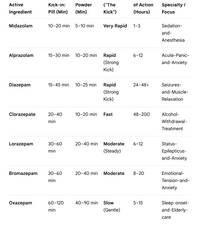
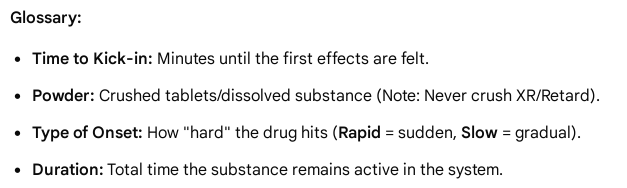
v. Below is a table showing how the benzodiazepines in question differ in their effects (time to onset, steepness of onset, and duration are, I think, the most important factors).
ii. Strictly speaking, especially if you are inexperienced with benzos, you should test the relevant benzos thoroughly beforehand. And then allow some time to pass to reverse the tolerance that may develop, particularly with high doses.
iv. I wonder if the PPEH isn't once again making things too easy for itself by selecting just any benzodiazepine at a high dose.
v. Below is a table showing how the benzodiazepines in question differ in their effects (time to onset, steepness of onset, and duration are, I think, the most important factors).
Last edited:


