• Hey Guest,

    We wanted to share a quick update with the community.

    Our public expense ledger is now live, allowing anyone to see how donations are used to support the ongoing operation of the site.

    👉 View the ledger here

    Over the past year, increased regulatory pressure in multiple regions like UK OFCOM and Australia's eSafety has led to higher operational costs, including infrastructure, security, and the need to work with more specialized service providers to keep the site online and stable.

    If you value the community and would like to help support its continued operation, donations are greatly appreciated. If you wish to donate via Bank Transfer or other options, please open a ticket.

    Donate via cryptocurrency:

    Bitcoin (BTC):
    Ethereum (ETH):
    Monero (XMR):
AreWeWinning

AreWeWinning

·
Nov 1, 2021
606
TL;DR Rope diameter may not matter much. Thicker ropes may just be as effective as thinner ones.

I usually follow threads about hanging, and the consensus appears to be that the rope shouldn't be too thick, because it may not block blood flow effectively. The logic is that surface area is inversely proportional to pressure, so for a given force, a thinner rope creates more pressure and blocks blood flow more effectively.

I have also been convinced that a thicker rope is less effective and can be problematic. However, I'm beginning to doubt whether this is really true. In this post, I'll explain what I mean. I'm also interested if anyone has any thoughts or personal experiences regarding this.

Research on tourniquets

What got me thinking is the scientific research on tourniquets (source). Research says that wider tourniquets are more effective at stopping blood flow and require less pressure. Note that contact pressure is not the same as the force used to tighten the tourniquet. Still, the relationship between width and required pressure cannot be ignored and is quite relevant.

Rules of physics:
  • For a given pressure, force is proportional to surface area. So if the required pressure were constant, wider tourniquets would require proportionally greater pulling force.
  • For a given surface area, force is proportional to pressure. So for the same tourniquet width, less pressure means less pulling force.
Let's consider both effects together. Wider tourniquets need lower pressure. Although the greater width of the tourniquet increases the pulling force required, that effect may be partly (or entirely) offset by the lower pressure needed to stop blood flow. In other words, wider tourniquets may need slightly less, slightly more, or a similar amount of pulling force to be effective.

I don't know how to calculate the pulling force from the pressure when it comes to tourniquets or ropes. However, I have a feeling that the idea of thicker ropes being less effective in hanging may be false. When it comes to ropes, it may not matter too much whether a rope's width is 12, 16, 20, or 25 mm (1/2, 5/8, 3/4, or 1 inch). A slightly thicker rope may be just as effective, or the difference may be insignificant.

Anecdotal evidence

First, there's anecdotal evidence to support this idea. For example, when I test losing consciousness, it doesn't matter whether I use a thin rope, a thick rope, or a belt. Seemingly, the amount of force I need to apply is roughly the same.

I'm not saying that using something overly thick (e.g. a bedsheet) would also work well. However when the thickness of the ligature is within reasonable limits (e.g. it's an actual rope), there is no practical difference in effectiveness in my experience.

Rope ≠ tourniquet

Research on tourniquets usually discusses standard-size tourniquets, typically 3.8 cm (1.5 inches) wide or wider. These tourniquets behave slightly differently from ropes, because ropes are usually 25 mm (1 inch) or less in diameter.

What's interesting is that the phenomenon I described above – that wider tourniquets require less pressure – is much more pronounced with narrower tourniquets. This is especially relevant when it comes to ropes, because ropes are quite narrow to begin with. If a tourniquet (or rope) is quite narrow, the pressure required to stop blood flow drops sharply as its width is increased. This effect is clearly visible in the graph below. (Source: Occlusion of Arterial Flow in the Extremities at Subsystolic Pressures Through the Use of Wide Tourniquet Cuffs, 1993, Graham et al.)
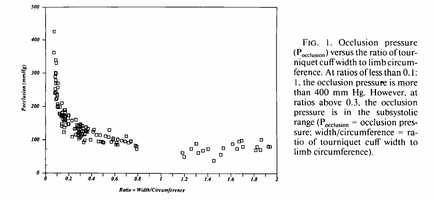
Occlusion pressure

I think this graph is very relevant when it comes to ropes around the neck. Any rope below about 25 mm (or 1 inch) would fall within the far left portion of the graph. This means that a thicker rope will require significantly less pressure to stop blood flow. I believe this is the reason why slightly thicker ropes work equally well as thinner ones.

Mechanism of action

It's also interesting to consider the reason why wider tourniquets require less pressure. I have looked at some research papers, and as far as I can tell, the exact physical or physiological mechanism is not known.

What is known is that surface pressure at the skin doesn't translate well to deeper tissues. This is why narrower tourniquets are less effective. The pressure has to be quite high to pinch and completely shut the arteries.

With wider tourniquets, surface pressure translates more effectively into deeper tissues. They may not shut the arteries completely, but even just compressing them over a longer section may create enough friction resistance to stop blood flow. As one research paper puts it:

It is possible that the different patterns of tissue pressure beneath narrow and wide tourniquets are associated with different mechanisms of flow reduction through compressed vessels. If a wide cuff produces a deformation in an artery that parallels its pressure profile, then blood flow would approach zero even without total collapse of the vessel because of the accumulation of frictional resistance to flow along the compressed length. On the other hand, flow elimination with a narrow cuff might require a pressure sufficient to collapse the vessel completely. Current models of flow in collapsible tubes have not explicitly considered this case. (internal citations omitted) (Source: Wide tourniquets eliminate blood flow at low inflation pressures, 1987, Moore et al.)​

So, what do you think? Are thicker ropes less effective, more effective, or is there no significant difference? What's your analysis or personal experience?
 
Last edited:
  • Love
  • Like
Reactions: GroundControl, fluorescentpearl and Realgar
JesiBel

JesiBel

protoTYPE:dcclxxvii
Dec 5, 2024
1,154
It's an interesting debate; I hope more users will participate.

I'm leaving a short draft exploring on the topic. I'm not a physics expert, so please correct me if I make any mistakes. I tried to explain it with my own limited words.


I think the action mechanisms of a tourniquet and a ligature (on the neck) are very different (although both require external pressure to compress the blood vessels).

Tourniquet:

Mechanical tension (manual, own physical strength), circumferential pressure to a limb. The force is controlled to compress deep arteries (that are under thick muscles) against a bone.

Pressure distribution: distribute pressure over a larger surface area ('wide' bands), to reach deep vessels while minimizing localized damage to the skin, nerves, and superficial tissues.

Ligature (hanging):

The force is created by gravity pulling down on the body mass. Directional tension, toward a specific point of suspension (anchor point). Increased pressure on the front and sides of the neck (using a self-tightening knot)

Pressure distribution: concentrate force onto a small surface area (ropes, cables, cargo straps, more or less "narrow" materials). The concentration leads to high localized pressure (V shaped mark on the neck).

The blood vessels on the neck (carotid arteries and jugular veins) are more superficial where the muscle layer is thinner and vulnerable to external pressure.

Smaller Area = Greater Pressure

If you increase the weight/force but keep the area the same, pressure increases.

(A person of little weight and a very thick rope would not be a good idea)

If you keep the weight/force the same but reduce the area, pressure increases.

1) For example: Hanging 20 kg weight tied on a leg.
(The force stays exactly the same in both cases, 20 kg, downward pull)

Thin rope: Small contact area - High pressure - Divides the force into a small space, causing the rope to dig into the flesh. More localized pressure.

Thick rope: Large contact area - Low pressure - Spreads the exact same force over a wider surface.

2) Changing the force (weight) and changing the area (rope thickness):

Example 1: Thick Rope + 10 kg weight tied on a leg, downward pull

10 kg creates a smaller pulling force
The thick rope spreads this small force over a wide surface (area).
A small force spread over a large area results in small pressure.

Lowest pressure: the smallest force combined with the largest area.

Example 2: Thin Rope + 20 kg weight tied on a leg, downward pull

20 kg doubles the pulling force
The thin rope compresses this heavier force into a small area. High pressure.

Highest pressure: the largest force combined with the smallest area.


From a practical view point: tying knots with a very thick rope is more awkward; they are more rigid and resist tight bends.

They would make some setups impossible since they wouldn't fit in certain places (for example, the rope over the door, passing the rope through a narrow gap).

In terms of effectiveness, I suppose it's how that force is distributed and the pressure it exerts.

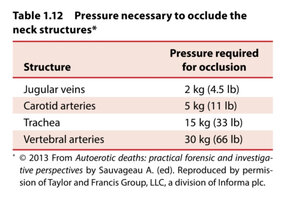
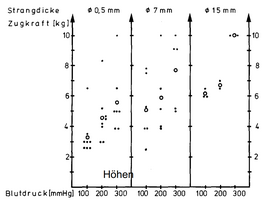
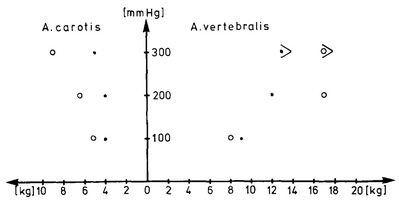
Early studies suggested that little weight was needed to occlude the blood vessels in the neck; even now, several forensic texts still cite this table:

1000215336

This appears to be incorrect, as these numbers were obtained in experiments with corpses, applying force perpendicularly to the blood vessels (corpse lying on a surface) and not obliquely as would happen in a real hanging case.

So it could be a combination of the person's weight and the material used to exert pressure.
 
  • Like
Reactions: AreWeWinning and Realgar
AreWeWinning

AreWeWinning

·
Nov 1, 2021
606
@JesiBel Thanks for your comment! I was beginning to wonder whether anyone would respond at all, and whether this question is too complex.

Regarding your comment, I think you may have missed some of the points I was making. Below, I'll try to highlight what they are.

Tourniquets vs. ropes

I think the action mechanisms of a tourniquet and a ligature (on the neck) are very different (although both require external pressure to compress the blood vessels).

Tourniquet:

Mechanical tension (manual, own physical strength), circumferential pressure to a limb. The force is controlled to compress deep arteries (that are under thick muscles) against a bone.

Pressure distribution: distribute pressure over a larger surface area ('wide' bands), to reach deep vessels while minimizing localized damage to the skin, nerves, and superficial tissues.

Ligature (hanging):

The force is created by gravity pulling down on the body mass. Directional tension, toward a specific point of suspension (anchor point). Increased pressure on the front and sides of the neck (using a self-tightening knot)

Pressure distribution: concentrate force onto a small surface area (ropes, cables, cargo straps, more or less "narrow" materials). The concentration leads to high localized pressure (V shaped mark on the neck).

I don't think tourniquets and ligatures (e.g. ropes) are very different. I think they're directly comparable. The only real difference is thickness, but this is why we're discussing them in the first place.

The question is not whether the force is circumferential or directional but how surface pressure translates to deeper tissues. The tissue doesn't "know" which direction the force is coming from. Regardless of the direction, the pressure caused by a thin ligature doesn't translate well to deeper tissues, where the arteries are located.

It is true that thinner ligatures create more concentrated pressure, but that fact does not undermine the argument: concentrated pressure is not required and may be less effective at stopping blood flow. If a ligature is very narrow (e.g. a rope) to begin with, increasing its width has a substantial effect: as width increases, the required pressure decreases steeply. This is clearly visible from the graph I posted.

On the graph I posted, ropes around the neck fall at the very left edge of the graph. An average neck circumference of 350 mm and an average rope width of 16 mm gives a Width/Circumference ratio of about 0.05. Look at where this is on the horizontal axis. In those ranges, even a minimal increase in ligature width results in a significant drop in required pressure.

Location of the arteries

The blood vessels on the neck (carotid arteries and jugular veins) are more superficial where the muscle layer is thinner and vulnerable to external pressure.

This isn't quite accurate. The carotid arteries run deep within the neck. The distance from the skin is similar to what it is at other parts of the body, e.g. the arms or the legs.

The veins are the vessels that are closer to the surface. This is also similar to how it is at other parts of the body.

Pressure vs. force

If you keep the weight/force the same but reduce the area, pressure increases.

1) For example: Hanging 20 kg weight tied on a leg.
(The force stays exactly the same in both cases, 20 kg, downward pull)

Thin rope: Small contact area - High pressure - Divides the force into a small space, causing the rope to dig into the flesh. More localized pressure.

Thick rope: Large contact area - Low pressure - Spreads the exact same force over a wider surface.

2) Changing the force (weight) and changing the area (rope thickness):

Example 1: Thick Rope + 10 kg weight tied on a leg, downward pull

10 kg creates a smaller pulling force
The thick rope spreads this small force over a wide surface (area).
A small force spread over a large area results in small pressure.

Lowest pressure: the smallest force combined with the largest area.

Example 2: Thin Rope + 20 kg weight tied on a leg, downward pull

20 kg doubles the pulling force
The thin rope compresses this heavier force into a small area. High pressure.

Highest pressure: the largest force combined with the smallest area.

I understand the relationship between pressure, force, and surface area. I very briefly commented on this in my post, in section "Research on tourniquets", under "Rules of physics". I understand that for a given force, thinner ligatures create more pressure and may be more likely to completely close the arteries.

However, research shows that complete closure of the arteries is not necessary. Quite the contrary: partially compressing arteries over a larger segment may effectively stop blood flow. This is why a narrow ligature and high amount of pressure aren't required, and this is why wider ligatures may be effective even if they produce less pressure.

Considering physics and the required force, the relationship roughly looks like this:
  • Same pressure requirement and thinner ligature ➡ less force required
  • Same pressure requirement and thicker ligature ➡ more force required
  • Less required pressure and thicker ligature ➡ a similar amount of force required
You may still wonder why it isn't necessary to completely compress the arteries to stop blood flow. First, we don't really need to know the exact reason, because experiments have already confirmed that it isn't necessary, and that wider ligatures are effective at lower pressures. Still, it's interesting to think about the why. The exact mechanism is unclear but likely related to blood viscosity and frictional resistance. Here is a study that discusses this:
The manner in which arterial flow is impeded by a wide tourniquet inflated to subsystolic pressure is not known. The analysis of blood flow within a collapsible tube is complex, owing to the non-Newtonian characteristics of blood, its variable viscosity under conditions of changing shear rates, and the autoregulation of biologic systems. The authors concur with Moore et al., however, that accumulation of frictional resistance along a segment of a blood vessel that is partially collapsed under a low-pressure pneumatic tourniquet may completely eliminate flow without actual occlusion of the vessel lumen. (internal citations omitted) (Source: Occlusion of Arterial Flow in the Extremities at Subsystolic Pressures, 1993, Graham et al.)

Thick ropes are awkward to work with

From a practical view point: tying knots with a very thick rope is more awkward; they are more rigid and resist tight bends.

This is a valid point, and I agree. An overly thick rope can be awkward to work with and is unnecessary. It is an important point to consider when choosing a rope.

Currently, I think any rope is fine as long as it is (a) strong enough and (b) easy to work with. Thicker ropes can be too stiff, which is not ideal. However, a slightly thicker rope (e.g. up to about 18–20 mm or 3/4 inch) should be fine if it's soft and easy to handle. Note that I'm talking about ropes. I still wouldn't recommend using something overly thick, like a bedsheet. I would also be cautious about using too much padding.

Early studies on forces required

Early studies suggested that little weight was needed to occlude the blood vessels in the neck; even now, several forensic texts still cite this table:
This appears to be incorrect, as these numbers were obtained in experiments with corpses, applying force perpendicularly to the blood vessels (corpse lying on a surface) and not obliquely as would happen in a real hanging case.

Yes, I agree that those values may not be accurate. I'm not really sure how to interpret them. Personally, I feel like I have to apply more than 5 kg of force to lose consciousness. However, this is not very relevant to the points I'm making regarding rope thickness vs. effectiveness.

So, have you experimented with losing consciousness? Is there a big difference in the amount of force you need to apply when you use a thinner or thicker rope, or when you use a belt or a strap?
 
Last edited:
  • Love
Reactions: fluorescentpearl
Gustav Hartmann

Gustav Hartmann

Enlightened
Aug 28, 2021
1,388
The pressure p on a cylinder, for example a neck or extremity is equal to the circumferencial force F divided by the radius of the cylinder r and the width d of the rope around the cylinder.

p = F/(d×r)

You can test this: Put your wrist in a noose and hang on your wrist and than put a noose around your thighs and hang on it. The pressure on the wrist is much higher. The radius of an elastic cylinder, like your neck will become smaller under pressure, so this effect is self-reinforcing. Regarding hanging: F is proportional to the bodyweight and a heavier person has normally a thicker neck, so this effect is compensated.

You can do the above test with different rope-diameters and you will find out that thinner ropes hurt much more. Imagine the effect of thin steel-wire used as a garrotte.

When I used my karate-belt for hanging, I observed that the belt is rolling around his longitudinal-axis, so that the full width cannot be applied.

I agree that a thick rope will exert enough pressure on the neck because the pressure to block the arteries is suprisingly low.

I don't understand how they found the formula that is presented in the graph. Obviously they think that the pressure on the neck must be higher than the blood pressure, what is true in principle. But with respect to hanging the pressure must be higher than the deformation resistance of the neck tissue. The intersection of rope and blood vessel is so small, that the blood pressure is irrelevant. When the rope digs into the neck the vessels are closed, no matter how high the blood pressure is.

I doubt, that the surface pressure on the skin doesn't translate well to the deeper tissue, because 75% of the tissue is water.
 
  • Like
Reactions: AreWeWinning
AreWeWinning

AreWeWinning

·
Nov 1, 2021
606
The pressure p on a cylinder, for example a neck or extremity is equal to the circumferencial force F divided by the radius of the cylinder r and the width d of the rope around the cylinder.

p = F/(d×r)

You can test this: Put your wrist in a noose and hang on your wrist and than put a noose around your thighs and hang on it. The pressure on the wrist is much higher. The radius of an elastic cylinder, like your neck will become smaller under pressure, so this effect is self-reinforcing. Regarding hanging: F is proportional to the bodyweight and a heavier person has normally a thicker neck, so this effect is compensated.

This is an interesting point, which I hadn't thought of. However, it doesn't really change my analysis. It makes sense that pressure is inversely proportional to limb (or neck) circumference, since reducing circumference reduces the surface area. We already know that reducing surface area increases pressure.

In any case, after reading your comment, I noticed another interesting fact which I hadn't considered: the graph I posted doesn't show whether the lower required pressure is a result of increased width or reduced circumference. Maybe this is also what you had in mind when you wrote your comment. While the graph may not be proof in itself, the study, and many other studies that did their own tests, explicitly make the claim that wider tourniquets require less pressure to work. The researchers who wrote these studies are generally smarter than us (at least speaking for myself), so I'm quite confident that they've compared various tourniquet widths on similar limb sizes before they came to their conclusion.

When I used my karate-belt for hanging, I observed that the belt is rolling around his longitudinal-axis, so that the full width cannot be applied.

I agree that a thick rope will exert enough pressure on the neck because the pressure to block the arteries is suprisingly low.

Regarding rope thickness, if I remember correctly from one of your earlier posts, are you planning to use a rope that's about 20 mm in diameter?

I don't understand how they found the formula that is presented in the graph. Obviously they think that the pressure on the neck must be higher than the blood pressure, what is true in principle. But with respect to hanging the pressure must be higher than the deformation resistance of the neck tissue. The intersection of rope and blood vessel is so small, that the blood pressure is irrelevant. When the rope digs into the neck the vessels are closed, no matter how high the blood pressure is.

I doubt, that the surface pressure on the skin doesn't translate well to the deeper tissue, because 75% of the tissue is water.

I'm not sure what your main point is here, but here are some thoughts that come to mind.

Regarding the graph, they didn't use a formula. They simply did the tests and plotted the results.

In my opinion, the fact that tissue is 75% water may be precisely why surface pressure isn't transmitted directly to an artery that is 1–3 cm below the surface. When the ligature digs into the tissue and pushes some tissue sideways, away from the ligature, this also requires force, which in turn reduces the force transmitted downward. Think of it this way: if you put a tube on a table and put a block of jelly over it, it takes more pressure to fully compress the tube by pressing on the jelly than it would if you pressed directly on the tube.

According to studies, it's not necessary to completely shut the artery to stop blood flow.

Regardless of the specifics, it seems we agree that a thick rope can still block the arteries. This is my main point. Rope thickness is not as important as some people may think, as long as it's within reasonable limits and the rope is easy to handle. Obviously, the rope also has to be strong enough.
 
Last edited:

Similar threads

N
Replies
14
Views
3K
Offtopic
Celerity
Celerity
E
Replies
7
Views
3K
Recovery
serenitydream
serenitydream
DarkRange55
Replies
1
Views
732
Politics & Philosophy
Catscratch
C