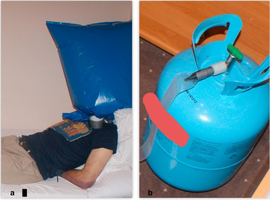
Putting the bag over the head by lowering it is probably not the best approach, since N₂O (especially when it's cold after evaporation of its liquid form) is denser than air and tends to flow downward at a direct contact with air (while the air will rise, displacing nitrous oxide above it). If the head is tilted so that the bag can be lifted towards the neck or at least moved horizontally, this should reduce the amount of air entered inside. As long as the percent of air doesn't exceed 25 - 30%, it shouldn't cause complications.
It was found that anaesthesia can be obtained with mixtures of nitrous oxide and air, provided the latter does not exceed 30 per cent. With 33⅓ per cent Hewitt failed to induce complete unconsciousness. With small percentages of air the symptoms were practically identical with those produced by the pure gas. The greater the proportion of air, the longer was the inhalation period before symptoms of anaesthesia appeared. Thus with 3 per cent and 5 per cent of air the average inhalation period was 69 secs.; with 30 per cent of air it was 148 secs.
It is an interesting fact that there was more anoxaemic convulsion with 3 and 5 per cent of air than with pure nitrous oxide, the explanation being that, in the absence of all oxygen, obstructive stertor comes about so quickly as to cut short the intake of the anaesthetic gas before the blood has become sufficiently altered to induce any marked convulsive seizure. With higher percentages of air the anoxaemic muscular phenomena progressively lessened, disappearing altogether with 30 per cent of air. With moderate percentages of air the clonic movements were but feebly marked.
The time to LOC is less than the time needed to produce anesthesia (basically a comatose state) mentioned above. In case of inhaling pure nitrous oxide through a mask,
The time which elapses between the commencement of the inhalation and loss of full consciousness is extremely short, about twenty to thirty seconds on the average.
This man succeeded with a relatively small bag (filled with helium)

tesble.com
By using a large bag (with a large amount of the gas) you extend the limit on the absolute amount of air that can enter inside and form a permissible proportion to N₂O, without critical impact on the effectiveness of asphyxiation.
As I said above, nitrous oxide is denser than air, and this feature should be taken into account when choosing the orientation of the bag and its relative position to the head.
If you manage to connect the parts well, it should provide correct readings. The question is how easy or difficult it would be to connect the CO₂ regulator to the N₂O cylinder. IDK whether such a construct would require adapters.
IDK. The tightening system seems to require more effort.
The configuration and protocol promoted by Exit International were designed mainly for old sick people who typically aren't quick, aren't dexterous, and barely capable of understanding physics. So the "classic" method is optimized for this category of people. It's likely that a closed bag system would work worse for them, because its use requires doing the steps with good coordination, speed, and understanding of the procedure (what you do and why). In case if the person has long hair (which is typical for women), this can also introduce some challenges with placing and sealing the plastic bag. When using a closed bag system, it's notably better to be bald or nearly so, while a ventilated system (with constant gas flow) should be suitable for people with long hair.