


vira
dont mean to come off rude. i like short convos.
- Apr 28, 2025
- 169

i guess this will be my little spot to talk about my thoughts. i am open to discussion and a light, differing opinion for flavor.
now, for me personally, i have never been one to believe in religion. more specifically, i am not one to believe in a god or creator. i think that our universe came from nothing, became something, and continues to be something, until it becomes nothing again. i just find a creator to be too close to what a human would want to exist.
back to the topic.
i struggle to understand the desire for connection and closeness with others. i try to empathize with people's situations, dealing with love and separation, but i dont think i will ever quite understand it.
what i dont understand? why would someone choose to be close with another person, knowing that their connection will result in separation. assuming that the two forge their bonds for a long while, eventually one will leave the other, right? whether from natural causes, or a falling out, it will happen eventually. i feel like these connections set eachother up for failure, for pain, for the opposite reasons they are created. and if we assume that we will pass before our loved ones, we are willingly putting them in a hurtful situation. isnt that against the goal?
i also find emotional validation a negative concept, which relates to my next question. emotions, at least from my perspective, are the main cause of mistakes, especially in reasoning. we can use a logical fallacy as an example:
- strawman: misrepresenting another's argument to validate your own. what reason would you have to invalidate an argument, without using logic, if not from a personal, emotional bias? how i see it, it can be caused by almost all emotions. happiness will result in overconfidence, anger will result in an unreasonable opposition- just to oppose, and so on.
i see that emotion connection makes people happy, that's reasonable. what i find odd, is placing your reasoning in jeopardy to feel what is most likely a fleeting emotion. lets use marriage as an example:
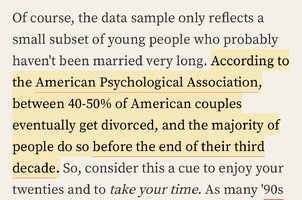
40-50%?! if we are aware that divorce causes significant distress, and we are also aware that ~45% of married couples (in the US, so, i guess you guys in europe/asia/australia/africa/etcetcetc may be luckier) end in divorce, why bother? it seems like a low reward, high risk situation. even more, the joy you receive in return doesn't even improve your judgement. what's the point?
judgement dictates everything controllable in our lives. i find that a very important aspect of my life, and i just cant understand why someone would willingly sacrifice that.


